
 German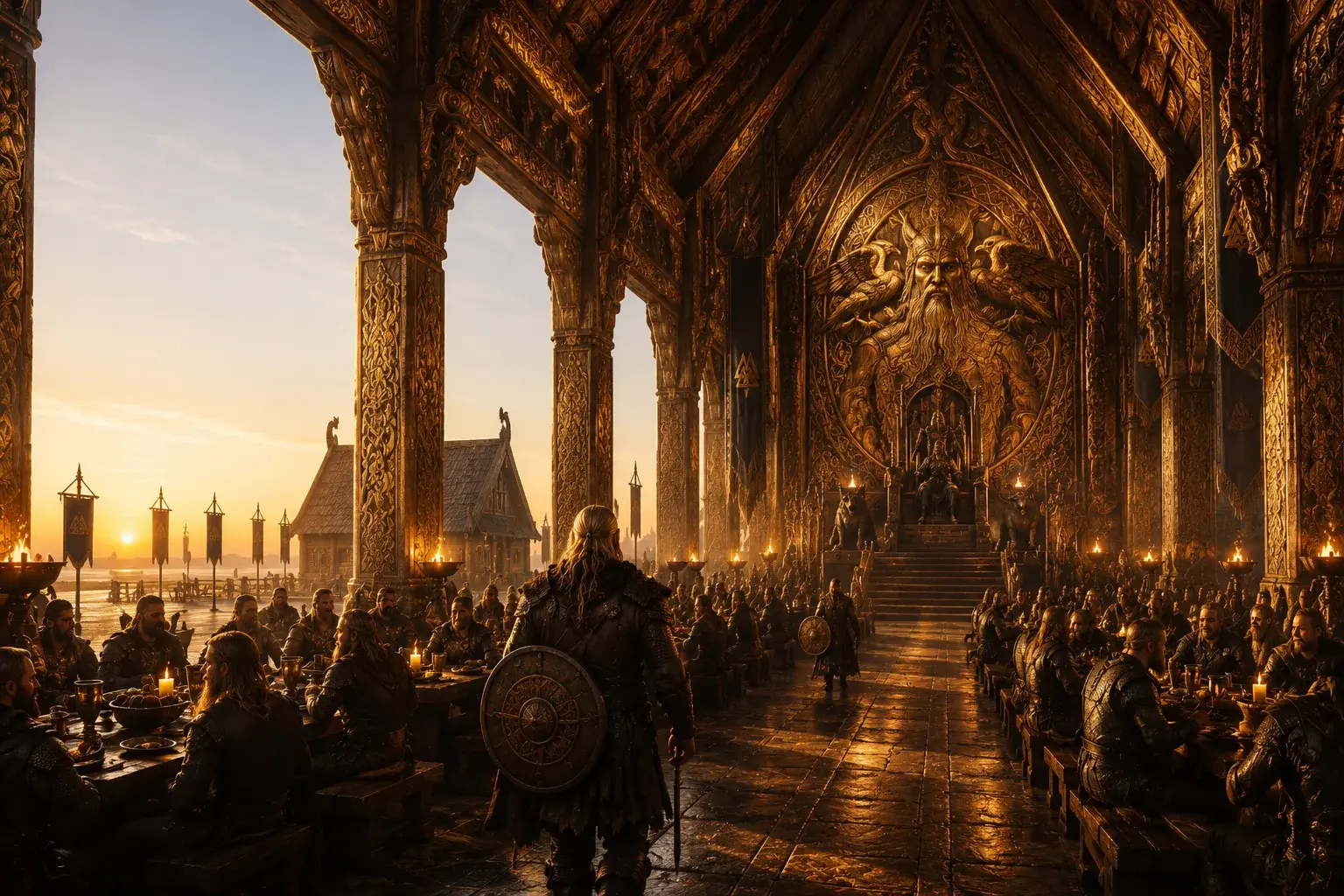
Introduction: The Hall of Eternity
Few concepts from Norse mythology are as famous today as Valhalla. In films, television series, novels, and video games, Valhalla is often portrayed as the Viking paradise—a place where brave warriors spend eternity feasting, fighting, and celebrating their glory.
The true Valhalla of the ancient Norse sources, however, is far more complex.
It was not simply a paradise, nor was it a place of eternal rest. Valhalla was the great hall of Odin, where fallen warriors were gathered and prepared for the most important event in the cosmic history of the Norse world: Ragnarök, the final battle that would bring about the destruction of gods, monsters, and the known universe.
In the myths, Valhalla stands at the center of the Norse warrior ideal. Here dwell the Einherjar, the chosen dead, who train endlessly for the day they will march beside Odin against the forces of chaos.
But why did such a belief emerge? Who was allowed to enter Valhalla? What role did it play in Viking society? And what do the ancient sources actually tell us about the most famous hall in Norse mythology?
The answers lead deep into the world of Odin, the Valkyries, the Einherjar, and the powerful ideas of honor, fate, courage, and death that shaped the Norse imagination for centuries.
What Is Valhalla?
Valhalla is the great hall of Odin located in Asgard, the realm of the Æsir gods.
According to Norse mythology, it serves as the home of many fallen warriors who have been chosen by the Valkyries after dying in battle.
These warriors are known as the Einherjar.
Their purpose is not simply to enjoy an afterlife of glory. Instead, they are gathered to form Odin's army for Ragnarök, the final battle between the gods and the forces of destruction.
Valhalla is therefore much more than a heavenly destination. It is simultaneously a royal hall, a military fortress, a sacred place, and a symbol of the Norse warrior ideal.
Not every deceased person entered Valhalla. Only a select number of fallen warriors were granted that honor.
This exclusivity made Valhalla one of the highest rewards imaginable in the Norse world.
The Meaning of the Name Valhalla
The word Valhalla comes from the Old Norse name Valhöll.
It is formed from two elements:
- Valr = the slain warriors of the battlefield
- Höll = hall
The name can therefore be translated as:
"Hall of the Slain."
This description perfectly reflects the purpose of Valhalla.
It was not a general afterlife for all people but a hall reserved for chosen warriors who had distinguished themselves through courage and honor.
Valhalla in the Norse Sources
Most of what we know about Valhalla comes from two major sources of Norse mythology:
The Poetic Edda
The Poetic Edda contains ancient mythological poems preserved in medieval Icelandic manuscripts.
Several of these poems describe Valhalla, Odin, the Valkyries, and the Einherjar.
One of the most important is Grímnismál, which provides detailed descriptions of Odin's hall.
The Prose Edda
The Prose Edda was written in the 13th century by Snorri Sturluson.
It preserves and organizes many older traditions and offers some of the most complete descriptions of Valhalla available today.
Historical Considerations
Both sources were written centuries after the Viking Age itself.
As a result, scholars must carefully distinguish between older pagan traditions, literary embellishment, and possible Christian influence.
Nevertheless, these texts remain our most valuable sources for understanding Valhalla.
Where Is Valhalla Located?
Valhalla is situated within Asgard, the realm of the Æsir gods.
Asgard is one of the Nine Worlds connected by Yggdrasil, the World Tree.
Among its inhabitants are:
- Odin
- Thor
- Frigg
- Baldr
- Tyr
- Heimdall
At the heart of this divine realm stands Valhalla, serving as both Odin's gathering place and the headquarters of his future army.
The Great Hall of Odin
The ancient descriptions of Valhalla are magnificent.
The hall is said to possess:
- 540 doors
- enormous chambers
- walls decorated with weapons
- roofs made from golden shields
According to the Eddas, hundreds of warriors can march through each gate at the same time.
These details are likely symbolic, emphasizing unimaginable size and power.
Valhalla is not portrayed as a peaceful paradise.
Instead, it resembles the headquarters of a divine military force preparing for an inevitable war.
Odin – Lord of Valhalla
No god is more closely connected to Valhalla than Odin.
Odin is:
- God of wisdom
- God of war
- God of magic
- God of poetry
- Lord of the slain
He gathers fallen warriors not merely to reward them but because he needs them.
Through prophecy and wisdom, Odin knows that Ragnarök will eventually arrive.
The gods will face destruction.
Chaos will be unleashed upon the cosmos.
To resist these forces, Odin spends ages gathering the bravest warriors into Valhalla.
The hall is therefore part of his long preparation for the end of the world.
The Valkyries – Choosers of the Slain
Between the battlefields of Midgard and the halls of Asgard stand the Valkyries.
These powerful female figures serve Odin and determine which warriors are worthy of entering Valhalla.
The name Valkyrie can be translated as:
"Chooser of the Slain."
Their duties include:
- Watching battles
- Selecting fallen warriors
- Escorting the chosen dead to Valhalla
In many myths, Valkyries are depicted as armored warrior maidens who ride across the sky and influence the outcome of battles.
Their role makes them essential figures in the Norse vision of fate and the afterlife.
Who Could Enter Valhalla?
A common modern misconception is that every Viking automatically entered Valhalla after death.
The sources suggest otherwise.
Valhalla was a place of distinction.
Only selected warriors who died in battle and were judged worthy by Odin's Valkyries could enter.
This exclusivity elevated Valhalla above ordinary conceptions of the afterlife.
It became the ultimate symbol of honor, courage, and heroic reputation.
The Einherjar – Odin's Army of the Dead
The inhabitants of Valhalla are known as the Einherjar.
These chosen warriors represent the true purpose of the hall.
Odin gathers them because they will one day fight beside him during Ragnarök.
Their existence revolves around preparation for that final conflict.
Valhalla is not the end of their journey.
It is the beginning of their final mission.
Daily Life in Valhalla
The daily existence of the Einherjar is one of the most fascinating aspects of Valhalla.
Unlike many modern visions of paradise, Valhalla is not a place of endless rest.
The chosen warriors do not spend eternity in peace.
Instead, every day follows a remarkable cycle.
At dawn, the warriors gather and enter battle.
They fight fiercely against one another using swords, spears, axes, and shields. The combat is real, brutal, and often fatal.
Many of the warriors are wounded.
Many are killed.
Yet death in Valhalla is not permanent.
When evening arrives, every warrior rises again. Their wounds disappear, their strength returns, and they gather together inside Odin's hall.
There they feast, drink, celebrate, and prepare for another day of combat.
This endless cycle reflects the true purpose of Valhalla:
The training of Odin's army for Ragnarök.
Sæhrímnir – The Eternal Feast
Among the strange and legendary beings associated with Valhalla is Sæhrímnir.
Sæhrímnir is a magical boar whose flesh provides food for all the warriors in Odin's hall.
Every evening the creature is slaughtered and cooked.
The Einherjar feast upon its meat.
Yet by the following morning, Sæhrímnir is alive once more, completely restored and ready to be sacrificed again.
This cycle continues forever.
The story reflects one of the recurring themes of Norse mythology: renewal through repetition.
Valhalla exists beyond the ordinary laws of the mortal world.
Heiðrún – The Goat of Endless Mead
Another remarkable creature connected to Valhalla is the goat Heiðrún.
According to the myths, she stands upon the roof of Valhalla and feeds upon the leaves of Yggdrasil, the World Tree.
From her udders flows not milk but an endless supply of mead.
This mead fills great vessels and provides drink for the Einherjar during their nightly feasts.
Mead held great significance within Norse culture.
It was associated with celebration, poetry, wisdom, hospitality, and divine inspiration.
The endless mead of Heiðrún symbolizes abundance and the generosity of the gods.
Why Not Every Warrior Entered Valhalla
Valhalla was not the only destination for fallen warriors.
This fact is often overlooked in modern interpretations.
The Norse sources tell us that Odin did not claim all of the dead.
Instead, another powerful deity shared this privilege.
That deity was Freyja.
According to the myths, Freyja received half of those who died in battle, while Odin received the other half.
This division reveals that the Norse afterlife was far more complex than many people imagine.
Fólkvangr – Freyja's Realm of the Fallen
Fólkvangr is the realm ruled by the goddess Freyja.
Its name is usually translated as "Field of the People" or "People's Field."
Freyja is one of the most important figures in Norse mythology.
She is associated with:
- Love
- Beauty
- Fertility
- Magic
- War
The sources state that she receives half of all slain warriors.
The remaining half are chosen for Valhalla.
Unfortunately, the surviving texts provide few details regarding the exact nature of Fólkvangr.
This mystery has made it one of the most intriguing locations in Norse mythology.
Valhalla and Helheim
Valhalla is often confused with Helheim.
In reality, the two realms are fundamentally different.
Helheim is the domain of Hel, daughter of Loki and ruler of the dead.
Many people who die of illness, age, or natural causes are believed to travel there.
Contrary to modern assumptions, Helheim is not equivalent to the Christian Hell.
It is not primarily a place of punishment.
Rather, it is a realm of the dead.
Valhalla, by contrast, is reserved for selected warriors chosen for a specific purpose.
The distinction demonstrates the complexity of Norse beliefs about death and the afterlife.
Valhalla and Ragnarök
The ultimate purpose of Valhalla becomes clear only through its connection to Ragnarök.
Ragnarök is the final battle and the end of the cosmic order.
The ancient prophecies describe a world consumed by chaos:
- The sun is darkened.
- The earth trembles.
- Fenrir breaks free.
- Jörmungandr rises from the sea.
- The armies of Muspelheim march to war.
When this day arrives, the gates of Valhalla will open.
The Einherjar will leave Odin's hall and join the gods in battle.
Everything they have done in Valhalla—the training, the fighting, the feasting—has been preparation for this single moment.
The Last Battle of the Einherjar
One of the most profound ideas in Norse mythology is that the gods know their fate.
Odin knows he will face Fenrir.
Thor knows he will confront Jörmungandr.
Many of the gods understand that death awaits them.
Yet they fight regardless.
This is one of the defining themes of the Norse worldview.
True heroism does not depend upon certain victory.
It depends upon courage in the face of inevitable defeat.
The Einherjar embody this ideal perfectly.
They prepare endlessly for a battle they know may be lost.
Their willingness to fight despite that knowledge transforms Valhalla into a symbol of bravery, loyalty, and determination.
Historical Origins of Valhalla
Where did the idea of Valhalla originate?
Historians believe that the concept evolved gradually over centuries.
Ancient Germanic and Norse societies placed great value on warrior culture, reputation, and loyalty.
Large halls occupied a central place within these societies.
The hall of a king served as a center of power, celebration, storytelling, and community.
Many scholars believe that Valhalla represents a supernatural version of such royal halls.
Odin becomes the ultimate king.
The Einherjar become his retainers.
Valhalla becomes the greatest hall imaginable.
Warrior Ideals in Norse Society
To understand Valhalla, one must understand the values of the Norse world.
Life in northern Europe could be harsh and uncertain.
Honor mattered deeply.
A person's reputation could outlive them.
Courage, loyalty, and determination were highly admired.
Valhalla reflects these ideals.
The hall celebrates not wealth or comfort but bravery and achievement.
The warrior who faced danger without fear earned a place among the chosen dead.
Archaeological Evidence
No direct archaeological evidence for Valhalla exists.
No inscription has ever been discovered that definitively proves its existence as a religious belief.
However, many Viking Age burials reveal strong beliefs regarding life after death.
Archaeologists have discovered graves containing:
- Weapons
- Jewelry
- Tools
- Animals
- Ships
These grave goods suggest that many Norse people believed existence continued beyond death.
Although they do not prove Valhalla itself, they support the broader idea of a complex and meaningful afterlife.
Christianization and the Transformation of the Myth
During the late Viking Age, Scandinavia gradually underwent Christianization.
As Christianity spread throughout Denmark, Norway, Sweden, and Iceland, many traditional Norse beliefs began to change.
The old gods lost their central role in religious life.
New ideas concerning Heaven, Hell, salvation, and the soul became increasingly influential.
Yet the ancient myths did not disappear overnight.
Many stories survived because they remained deeply rooted in cultural memory. Icelandic scholars and writers preserved numerous traditions that might otherwise have been lost forever.
Valhalla was among the beliefs that endured.
Over time, however, its meaning evolved.
Some medieval writers interpreted Valhalla as a pagan counterpart to Heaven.
Others viewed it as a symbol of a heroic and legendary past.
As centuries passed, Valhalla transformed from a religious concept into one of the most recognizable symbols of Norse culture.
Valhalla in the Viking Age
For many warriors of the Viking Age, reputation was one of the most valuable possessions a person could have.
Wealth could be lost.
Kingdoms could fall.
Even great leaders would eventually die.
But a respected name could survive for generations.
The idea of Valhalla fit perfectly within this worldview.
To be chosen by the Valkyries meant that one's courage and achievements would be remembered.
Whether every Viking literally believed in Valhalla exactly as later sources describe it remains uncertain.
What is clear, however, is that concepts of honor, fame, heroic death, and remembrance played an enormous role in Norse society.
Valhalla became the ultimate expression of those values.
Valhalla in Modern Literature and Popular Culture
Few locations from world mythology have had as much influence on modern popular culture as Valhalla.
The hall appears in:
- Fantasy novels
- Historical fiction
- Films
- Television series
- Video games
- Music
- Modern pagan traditions
The image of fallen warriors gathering in Odin's hall has captured the imagination of people around the world.
In many modern depictions, Valhalla is simplified into a warrior paradise.
The original sources present a more nuanced picture.
Valhalla is not simply a reward.
It is a place of preparation, duty, and destiny.
Its inhabitants are not resting forever.
They are waiting for the final battle.
Valhalla in Movies, Television, and Gaming
Modern media has introduced Valhalla to audiences far beyond Scandinavia.
Series such as Vikings and numerous fantasy productions frequently reference Odin's hall.
The concept gained even greater popularity through video games, especially titles centered on Norse mythology and Viking culture.
These adaptations often blend authentic mythology with creative reinterpretation.
While historical accuracy varies, the central image remains remarkably consistent:
Valhalla is the destination of brave warriors who face death without fear.
This powerful symbolism continues to resonate with modern audiences.
The Enduring Appeal of Valhalla
Why does Valhalla continue to fascinate people more than a thousand years after the Viking Age?
Part of the answer lies in the universal questions it addresses.
Every culture seeks to understand:
- What happens after death?
- What makes a life meaningful?
- How should people face hardship and uncertainty?
- What legacy do we leave behind?
The Norse answer was unique.
The gods did not promise safety.
They did not guarantee victory.
Instead, they celebrated courage, perseverance, and honor even in the face of inevitable loss.
Valhalla represents the belief that dignity comes not from avoiding struggle but from confronting it.
This idea remains deeply compelling today.
Valhalla as a Symbol of Courage
At its core, Valhalla is about more than warriors and battles.
It represents a philosophy of life.
The heroes of Norse mythology know that suffering, loss, and death are unavoidable.
Yet they continue forward.
Odin gathers warriors despite knowing Ragnarök will come.
The Einherjar train despite knowing the final battle may be unwinnable.
The gods fight despite understanding their own fate.
This willingness to act in the face of uncertainty forms one of the most enduring themes of Norse mythology.
Valhalla stands as the ultimate symbol of that mindset.
Conclusion
Valhalla is one of the most famous and influential concepts in Norse mythology.
Far more than a simple afterlife, it is a hall of honor, preparation, and destiny.
Within its walls dwell the Einherjar, chosen warriors who train for Ragnarök under Odin's watchful eye.
The myths of Valhalla reveal a culture that valued courage, loyalty, reputation, and perseverance above comfort and security.
Even today, the image of Odin's hall continues to inspire people around the world.
Its enduring appeal lies not merely in its grandeur but in the message it conveys:
True greatness is not measured by guaranteed success.
It is measured by the willingness to face one's fate with courage.
Frequently Asked Questions (FAQ)
What does Valhalla mean?
Valhalla means “Hall of the Slain” and refers to Odin's great hall in Asgard.
Who goes to Valhalla?
According to Norse mythology, selected warriors who die in battle and are chosen by the Valkyries may enter Valhalla.
Is Valhalla a paradise?
Not in the traditional sense. Valhalla is a place of preparation, training, feasting, and duty rather than eternal peace.
What is the difference between Valhalla and Fólkvangr?
Valhalla belongs to Odin, while Fólkvangr is the realm of the goddess Freyja. Both receive portions of the fallen warriors.
What is the difference between Valhalla and Helheim?
Helheim is the realm ruled by Hel and is associated with many who die natural deaths. Valhalla is reserved for chosen warriors.
Who are the Valkyries?
The Valkyries are supernatural female figures who select worthy warriors from the battlefield and escort them to Valhalla.
Who are the Einherjar?
The Einherjar are the chosen dead who reside in Valhalla and prepare for Ragnarök.
Is there historical evidence for Valhalla?
There is no direct archaeological proof of Valhalla itself, but Norse burial practices suggest strong beliefs in an afterlife.
Why is Valhalla still famous today?
Valhalla remains popular because of its powerful themes of courage, honor, destiny, and heroic perseverance, which continue to inspire people worldwide.
Is Valhalla the same as Walhalla?
Yes. “Valhalla” is the internationally recognized form derived from Old Norse, while “Walhalla” is the traditional German spelling of the same concept.


